
'This escalation was definitely not part of Gen Z's plan. It seems now that these external forces were keenly observing the initial developments from the sidelines and jumped into the fray, taking advantage of the situation, finding that the time was suitable for such acts'

An NGO claimed that its documentary cast a slur on the reputation of India, its judiciary and Prime Minister Narendra Modi.

The Supreme Court of India has dismissed a public interest litigation (PIL) seeking to make dowry harassment and maintenance provisions "gender neutral." The court stated that it cannot legislate law and it is the responsibility of Parliament to look into such matters. The PIL, filed by an NGO, argued that these provisions are often misused to harass husbands and their families. The court, however, emphasized that every case must be judged on its own merits, and that the provisions are intended to protect women and children. The court also noted that the allegation of misuse was vague and that such claims should be examined on a case-by-case basis.

Its August 11 direction, which prohibits the release of stray dogs from dog shelters, shall be kept in abeyance for the time being, the apex court said.

A two-judge bench of the top court had on August 11 directed authorities in Delhi-National Capital Region (NCR) to start picking up stray dogs from all localities "at the earliest" and relocate the animals to dog shelters.
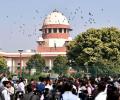
The Supreme Court has begun hearing petitions challenging the Election Commission's decision to conduct a special intensive revision exercise in Bihar ahead of elections, raising concerns about voter exclusion.
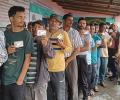
The Election Commission has assured the Supreme Court that no voter's name will be deleted from the draft electoral roll in Bihar without prior notice and a fair hearing. The EC also clarified that it is not required to share separate lists of those not included in the draft rolls.

The Supreme Court's order to remove stray dogs from Delhi-NCR localities has sparked mixed reactions, with RWAs welcoming the move and animal rights activists raising concerns about implementation and potential harm.

'Day by day we expose how soulless we have become as a society. Every day is a disappointment.'
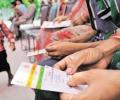
Expressing surprise over political parties not coming forward in filing objections related to 65 lakh excluded voters, the top court directed the chief electoral officer of Bihar to implead them in the court proceedings.
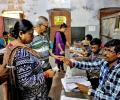
The Supreme Court of India has asked petitioners in two Public Interest Litigations (PILs) to make representations to the Election Commission of India (ECI) regarding their demand for uploading polling booth-wise voter turnout data on the ECI website. The PILs, filed by TMC MP Mahua Moitra and NGO Association for Democratic Reforms, seek a direction for the ECI to upload the data within 48 hours of the conclusion of polling in Lok Sabha and assembly elections. The ECI, represented by senior advocate Maninder Singh, expressed willingness to deliberate on the matter and suggested a meeting with the petitioners to address their concerns. The court has adjourned the hearing to the week of July 28.
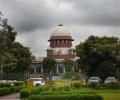
A bench of Justices Sudhanshu Dhulia and Joymalya Bagchi, however, questioned the timing of the exercise, besides offering its prima facie view that Aadhaar card, voter ID card and ration cards could be considered during the SIR in Bihar.
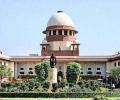
The Supreme Court of India has scheduled a hearing on February 19 for pleas challenging the appointment of the Chief Election Commissioner and Election Commissioners under the 2023 law. The court emphasized the potential consequences if any action is taken before the hearing. The pleas argue that the 2023 law, which excludes the Chief Justice of India from the selection panel, undermines the independence of the Election Commission and allows for undue influence from the executive branch. The court's earlier verdict in March 2023 called for an independent selection panel comprising the Prime Minister, Leader of the Opposition, and the Chief Justice of India to ensure the integrity of the Election Commission. The case highlights concerns about the independence of India's electoral process and the potential for political influence in the appointment of key election officials.

The Uttarakhand high court on Monday sought replies from the state government and central agencies within 48 hours on the ongoing operation and measures taken to rescue 41 workers trapped inside a partially collapsed tunnel in Uttarkashi for more than a week.
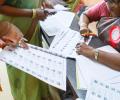
The Supreme Court has agreed to hear petitions challenging the Election Commission's decision to revise electoral rolls in Bihar. The hearing is scheduled for July 10.
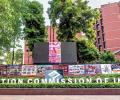
The Supreme Court will hear on February 19 pleas challenging the appointments of the Chief Election Commissioner and Election Commissioners under the 2023 law. The court will take up the matter on a priority basis, after some urgent listed matters. The government has appointed a new CEC and ECs under the new law, which excludes the Chief Justice of India from the selection panel, despite a 2023 Supreme Court verdict directing the inclusion of the CJI in the panel. The petitioners argue that the exclusion of the CJI undermines the independence of the election commission.
The Supreme Court of India has sought the government's response on a Public Interest Litigation (PIL) that challenges the appointment process of the Comptroller and Auditor General of India (CAG), arguing it's unconstitutional. The PIL, filed by the Centre for Public Interest Litigation, claims the current process, solely through executive appointment by the Prime Minister, undermines the CAG's independence and violates constitutional principles. The court, while acknowledging the importance of institutional trust, questioned the extent to which it should intervene in the appointment process and whether this would constitute rewriting constitutional provisions. The PIL suggests the CAG's appointment should be similar to other independent bodies, with a selection committee comprising the Prime Minister, Leader of the Opposition, and Chief Justice of India. The case has implications for the independence and transparency of India's audit system.

The Supreme Court has adjourned pleas challenging the appointments of the chief election commissioner (CEC) and election commissioners (ECs) under the 2023 law. The court indicated the matter would be listed after the Holi festival break due to a paucity of time. Petitioners, including the NGO Association for Democratic Reforms, argued for an urgent hearing, emphasizing the importance of the issue and the potential impact on democratic processes. The appointment of the new CEC and ECs under the 2023 law, which excludes the Chief Justice of India from the selection panel, has been a point of contention, with petitioners alleging it undermines the independence of the election commission.
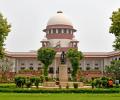
The Supreme Court will hear a plea seeking an independent selection process for the Comptroller and Auditor General of India (CAG) on March 17. The PIL, filed by the Centre for Public Interest Litigation, argues that the current system of appointment solely by the executive and the prime minister violates the Constitution and undermines the CAG's independence. The petition calls for a transparent process involving the prime minister, Leader of the Opposition, and Chief Justice of India. The PIL contends that the CAG's role as a watchdog over government finances requires a fair and non-arbitrary appointment procedure.

A bench of Chief Justice DY Chandrachud and Justices PS Narasimha and Manoj Misra will be hearing the petition filed by NGO Manipur Tribal Forum.
Writing his views in a separate verdict while concurring with the opinion of Justice Sanjiv Khanna, who was heading the bench, Justice Datta said the question of reverting to "paper ballot system", on facts and in the circumstances, does not and cannot arise.
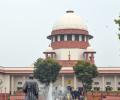
The Supreme Court is scheduled to hear on March 18 a plea seeking to debar from polls, candidates charged with serious offences. The plea, filed by advocate Ashwini Kumar Upadhyay, seeks directions to the Centre and the Election Commission of India (ECI) to restrain such candidates put on trial for serious offences. The plea alleges that despite recommendations of the Law Commission of India and court's previous directions, the Centre and the ECI did not act. The plea also highlights the increasing number of MPs with declared serious criminal cases since 2009, with one MP declaring 204 criminal cases against him, including culpable homicide, house trespass, robbery, criminal intimidation, etc. It claims that political parties are competing with each other in a race to the bottom as they couldn't afford to leave their competitors free to recruit persons with criminal antecedents.

"We don't want people going after Muslims and Kashmiris," Himanshi Narwal said on Thursday, stoic and firm as she mourned her husband, Naval officer Lieutenant Vinay Narwal, who was gunned down in Pahalgam just 10 days ago. He would have been 27 on Thursday.

Chief Justice of India Sanjiv Khanna on Tuesday recused from hearing a batch of pleas challenging the exclusion of the CJI from the panel meant for selecting the chief election commissioner and election commissioners. The CJI, who was sitting on the bench with Justice Sanjay Kumar, told the advocates appearing for the PIL petitioners that he couldn't hear the pleas now. The cases will now be listed before another bench after the winter break.
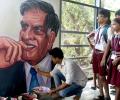
The Delhi High Court has ordered a journalist not to host an award event using the name "Ratan Tata National Icon Award" or the trademarks "Tata" and "Tata Trusts". The court found that Ratan Tata's name and the Tata trademarks are protected and that the journalist's use of them was unauthorized. The case was filed by Sir Ratan Tata Trust and Tata Sons Pvt Ltd, who alleged that the journalist's actions caused harm to their reputation and goodwill. The court also ordered the journalist to stop using the logo and pictures related to Ratan Tata and Tata Trusts.
In a significant development, the Supreme Court on Tuesday asked the Election Commission of India to provide details of cases in which it had either removed or reduced the period of disqualification from electoral rolls of leaders post their conviction in criminal cases.

Congress leader Rahul Gandhi has criticized the government's decision to appoint Gyanesh Kumar as the new Chief Election Commissioner (CEC) in the middle of the night, arguing that it is "disrespectful" and "discourteous" given the ongoing Supreme Court challenge to the selection process. Gandhi presented a dissent note to the selection committee, stating that the process violates the Supreme Court order and undermines the integrity of the electoral process.
The ministry of home affairs has suspended the Foreign Contribution Regulation Act (FCRA) licence of prominent public think-tank Centre for Policy Research (CPR) over violation of laws, officials said on Thursday.
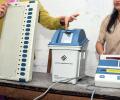
The Supreme Court of India has sought a response from the Election Commission of India (ECI) regarding pleas seeking verification of burnt memory and symbol loading units in Electronic Voting Machines (EVMs). The court directed the ECI to refrain from erasing or reloading data during the verification process and to explain the procedure adopted for verification. The bench also expressed concerns over the high cost of verification and directed the ECI to reduce the fee. The court's directive comes following its previous judgement where it allowed aggrieved candidates to seek verification of EVMs.
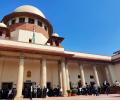
The Supreme Court on Monday agreed to consider listing for urgent hearing the petitions challenging the constitutional validity of the Waqf (Amendment) Act, 2025.
The Supreme Court of India expressed concerns about the long-term sustainability of providing free rations to migrant workers, emphasizing the need for job creation and capacity building instead. The court's remarks came during a hearing on the ongoing issue of providing relief to migrant workers, a matter that gained prominence during the COVID-19 pandemic. The court questioned the government's reliance on freebies and stressed the importance of creating opportunities for migrant workers to become self-sufficient. The debate highlighted the challenges of balancing immediate relief with long-term economic solutions for vulnerable populations.
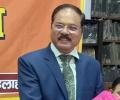
Justice Shekhar Kumar Yadav, an Allahabad High Court judge, is set to appear before the Supreme Court Collegium to explain his controversial statements made at a Vishva Hindu Parishad (VHP) function. The Supreme Court has sought a report from the Allahabad High Court after news reports surfaced regarding Justice Yadav's remarks, which were widely condemned as "hate speech". The judge's statements, made at a VHP event, sparked outrage from various quarters, including opposition leaders and lawyers. The Bar Association of India has also condemned the judge's remarks and called for an apology.
The Delhi high court has slapped Rs 10 lakh costs on an NGO which had filed a Public Interest Litigation (PIL) alleging unauthorised construction in New Delhi, saying it was unfortunate that the noble forum of PIL was being used for blackmailing citizens.

A three-judge Supreme Court bench will hear petitions challenging the constitutional validity of the Waqf (Amendment) Act, 2025, on April 16. The petitions, including those by politicians and the All India Muslim Personal Law Board (AIMPLB) and Jamiat Ulama-i-Hind, were filed in the top court challenging the validity of the newly-enacted law. The Centre has filed a caveat in the apex court, seeking a hearing before any order is passed.
It will be court's opinion versus the legislative power to enact law, the Supreme Court on Wednesday said as it posted the pleas challenging the appointment of the chief election commissioner and election commissioners under the 2023 law on February 4.

Alleging that the NGO allows its name to be used "at the behest of some selected political interest", the Union of India told the top court that it is guilty of collecting huge funds by exploiting the agonies of riot-affected people.
The Supreme Court of India will likely hear a batch of petitions challenging the constitutional validity of the Waqf (Amendment) Act, 2025 on April 15. The Act, which came into force on April 8, has been met with widespread criticism from various stakeholders, including politicians, the All India Muslim Personal Law Board (AIMPLB), and Jamiat Ulama-i-Hind. They argue that the law is discriminatory and violates the fundamental rights guaranteed under Articles 25 and 26 of the Constitution. The petitions allege that the amendments give the government more control over the administration of Waqf, effectively sidelining the Muslim minority from managing their own religious endowments.

The NGO challenges the validity of a provision of the Chief Election Commissioner and Other Election Commissioners Act, 2023.
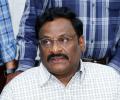
In a statement, the non-governmental organisation underscored the challenges Saibaba faced during his incarceration and the toll it took on his health.

Her sister, who was 13 at the time, later told Sonia about the violence and killings of people from the Sikh community following former prime minister Indira Gandhi's assassination, she said in Delhi on Saturday at a press conference commemorating the 40th anniversary of the riots.
 © 2026 Rediff.com - Advertise with us - Disclaimer - Privacy Policy - Sitemap - Feedback - About us - Terms of use - Grievances